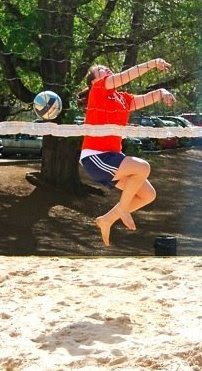
While I echo this optimistic sentiment, I know that it just isn't always possible, particularly when you're reaching into the upper limits of your abilities. I also, somewhat suprisingly, hear strong climbers lament that they thought they were in such good shape, yet they got their butts kicked at hot yoga, or they can't believe how sore they are from sand volleyball. Of course you are! You're in good climbing shape... not good yoga shape. The two things are completely different, and you'd be hard pressed to convince me of any crossover fitness.
Now, I don't often do this, but I thought this blog post was worth reposting...it's a blog I follow, well written and often insightful commentary on how the body moves and functions. It isn't so much about the physiology as it is the "essence" of movement. At any rate, this post, "Extreme Performance or Optimum Health? Pick One!", hit the nail on the head.
Read it and choose your path, but choose wisely.
Otherwise, you might just suck at sand volleyball forever.
This may be splitting hairs, but I have issues with the article's lack of definition of "extreme performance" and "health." What do those mean? Sure, at the highest levels of any sport you have to specialize, but I don't think this applies to 99% of people (or 99.9%, really). I think a more appropriate commentary would be on how 99% of people don't have enough time to try and excel at more than one sport/discipline/hobby and how it's okay to put all your eggs in one basket.
ReplyDeleteI think he's talking about movement health. I don't know any dedicated athlete (unless you count maybe crossfit as a sport, which I do not) who has healthy movement. Its nearly always evolved to support their sport, but hinders other movements.
DeleteHey Kris,
ReplyDeleteI have a somewhat unrelated question to this particular post. In trying to obtain higher performance, I've added regular hangboarding to my workout. I've added weight and am up to an additional 50 lbs of weight plus body weight on a 3/4" edge. I was wondering how heavy is safe to go without destroying my shoulders and elbows. I weigh 160 lbs, so 50 lbs is already almost a third of my body weight. I know you aren't a doctor, but I would be curious to know what percentage of your body weight you add to your hangboard work out?
Second unrelated question, I've started seeing some references to high/low training originally used for track athletes being applied to climbing. I was wondering if you had any thoughts on this type of training for climbing? If so, how would you apply it?
Thanks for sharing your wealth of knowledge and experience with the community. I can't speak for anyone else, but I know I appreciate it.
Funny you ask these questions... I'm asking them myself.
DeleteI've tried experimenting with heavy weights, up to nearly half my bodyweight. All it did was completely wreck my skin so that I could barely climb or train. I switched gears to never going over 20 lbs, at which point I would move to fewer fingers and smaller holds. However, now that I'm using wooden holds, I'm considering going back up in weight, to 50 lbs (which is just over 1/3 of my bodyweight). That will be incorporated into my next strength phase.
Even stranger that you bring up high/low training. I've been trying to find the original books by Charlie Francis detailing this training, as I'm very curious. I feel my biggest gains yet to be had will come in the strength and power dept., and his system is essentially a refined version of what I currently do. I plan on using it this summer as well.
But, to answer your question, I don't think I'd prescribe high/low training to anyone who isn't already climbing above the 5.13 level. Reason is, there is alot to be learned about the mental game in those middle intensities that high/low cuts out. Most important, how to deal with the mental aspects of climbing while extremely fatigued. I believe that High/low training can more effectively prepare you physically, but there is so much more to climbing hard than just being physically prepared.
Hey Kris,
ReplyDeleteThanks for the quick response. As a quick side note, I can climb most 5.13a's within 3-6 days of effort, maybe 6-15 burns. At this point in time, I like mini-projects, but I have started eyeing some 13b's and c's for more of a real project. I also plan on applying some better tactics this year, because I usually just try each attempt from the ground up and don't spend a lot of time working out sections. So hopefully with better tactics, I can do 13a in 1-3 days effort and do some 13b's in the 3-6 day range and maybe a 13c for my very own "Swing Line".
In regard to fingerboard training, I think I am going to try a 12 week cycle of 3 weeks of heavy weight (up to 50 lbs), 1 week off, 3 weeks of medium weight (up to 25 lbs) on smaller holds or less fingers, 1 week off and then 3 weeks of no weight on the smallest holds/least amount of fingers I can do and see how that goes. I'm still searching for what works best while minimizing the chance of injury.
If you find anything more about the high/low training that you think you can apply to climbing, I would love to know about it. I have been trying to find time to research a little more on how 400M and 800M sprinters train (how much time they spend on each of strength, power and endurance, how they structure their workouts, etc.). I think they may be the closest match to sport climbing in regards to needing all 3 components, so I need to find some time to look into that.
Cheers!
Tactics will make a world of difference!
DeleteI'll be posting on here about my plan with high/low training by end of spring. I'm reading both training books written by the creator of the system, Charlie Francis, and trying to convert it to climbing. So far I'm sold... but we'll see.
Great. I look forward to seeing how you convert the high/low principles to climbing and perhaps more importantly, how well you think they work.
DeleteGreat post. I just located your blog and wished to let you know that I have certainly loved reading your blogs. At any rate I’m going to be subscribing to your feed and I really hope you are writing again soon.
ReplyDeleteGlad you found us! More to come soon for sure.
Deletegreat blog!it's very informational.hope make more like this. GET EPX
ReplyDelete