
Reader Questions: The Clock is Ticking.

Frankly, this question and it's variances are far too common. "I'm leaving for Hueco next week... what should I do to get ready?". If you're in that situation, and you can't rewind time, then you might be out of luck. Sorry. My friend Arthur, however, has a little more time to prepare, and offered up a great question that can be pertinent to many of us at one time or another.
10:26am, Arthur Cammers:
Topic for Power Co.
I'm a month away from a climbing trip at which I want to perform well. What is the optimal program for overall climbing fitness? I want strength and enduro. I am planning 3 days on, 1 rest day, and 3 more days on.
10:27am, Kris Odub Hampton:
Where are you going and what have you been doing leading up to this point?
AC: Indian Creek.
Bouldering indoors due to inclement conditions.
Thought it would be an interesting topic. It is always pertinent. At some point EVERYONE who takes climbing trips is a month away from the event.
Mull it over, Kris.
KOH: It is, and is especially specific. I guess traddies are climbers, too...
In all seriousness, I've got some good ideas. What specific routes do you want to do? Do you mind if I use your name in the blog?
AC: You can use my name and the fact that I suck.
Routes: "We Are Omnivorous", anything--everything mid 10 to mid 11.
KOH: Haha. Ok. It'll be the next post. Expect it by the end of the weekend.
Arthur's case is pretty specific, as preparing for Indian Creek is completely different than preparing for any other climbing trip. However, assuming that you have the dedication to maximize your time, then anyone can get send ready in just 4 weeks, for any climbing trip. I'll outline these, and I'll tackle Art's case specifically. Also, I'll be assuming that the trip you're planning for is the common 1-2 week trip in which you want to climb as many days as possible. The schedule will reflect this, but can be changed to fit any climbing schedule.
Besides the physical training aspect, there are a couple of points that you should follow throughout the entire 4 week process.

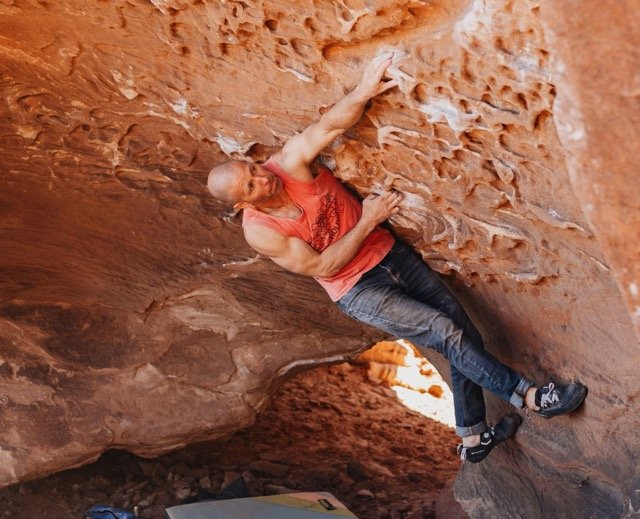
Art Cammers at 48. No diet required.
1. Fuel.
This is simple, and for some of us, the hardest to stick to. Being that strength to weight ratio is such an important part of climbing to your potential, you'll want to make the most of it. You aren't going to get much stronger in 4 weeks, but you might be able to lose a little excess weight. 5 pounds can make an enormous difference, particularly in the final, flaming moves of a hard redpoint. Your best bet, if you don't already follow a fairly healthy diet, is to make simple changes. Cut out sodas, sweets, and unnecessary sugars. Drink more water. Take fruits and veggies as snacks instead of chips. Eat smaller portions, and do it more often, rather than getting famished and gorging on one big meal. You aren't looking for a complete overhaul, and you certainly aren't looking to stop eating. You'll need lots of calories to sustain the amount of training you will be doing - just make sure that it's good fuel.
Arthur, ignore this. You have no reason to change a damn thing concerning your diet, because the "weight" portion of the strength to weight ratio, for you, has reached it's zenith. Keep doing what you're doing, and focus on getting better and stronger.
2. Quality.
Make your workouts count. Most of us have a career, or kids, or other hobbies, or all of the above, and don't have all day to train. If we did have all day, we'd already be on that trip, wouldn't we? So we have to prioritize our training, and do what will benefit us the most in the short period of time we have. One way to ensure this is, no matter what workouts you choose, make sure they are high quality. Don't cheat yourself when it comes to keeping form and trying hard. During your warm ups, pay extra close attention to climbing with perfect technique (Art, this is for YOU!), and continue that through the entire workout. It's those things that will make the difference when your core starts to sag at the top of that long pitch.
3. Be Specific.

Laps and laps and laps.
If you're headed to Wild Iris for a week, there is no reason to spend energy working on slopey compression problems. Art, Indian Creek isn't going to give a damn that you've sent the new black tape on the 60 degree wall. It'll laugh at you. My point is, train for your objective. If you are coming to the Red, you'll want to be on overhanging jugs for a LONG time. Smith Rocks? Vertical crimps and pockets. Horsepens? Big slaps to big slopers.
Art, spend time on cracks when you can. Laps on cracks. Laps of laps on cracks. Laps on top of laps of laps on cracks. Really LEARN the different jamming and locking techniques rather than bullying your way up a 35 foot "pitch". In the event that you're stuck in the gym and can't get to actual cracks, stay off the steep walls. Spend your time on the vertical to lightly overhanging walls, climbing on bad holds, and learning the balance required. Use the absolute worst footholds you can find. Smear on them rather than trying to edge on everything. If you've got the advantage of being able to set problems, set something with sidepulls and gastons, all in a line, with bad feet nearly directly beneath you. Balance. Learn it.
Now, about the actual training portion of this month...
Weeks 1 and 2:
Day 1. Day 3. Day 5. Hangboard and Core.
I won't tell you how to use a hangboard here... that's a whole 'nother post. Conveniently, I've already written that one. If you have a workout that you love... use it. However, remember that you have limited time so you need to be specific. If I were going to Wild Iris, I'd spend alot of time hanging on just two fingers. Rumney? I'd be on tiny crimps.
Art, you absolutely could use a crack hangboard. They are extremely easy to build, and depending how complex you want it to be, can be fully adjustable. The easy ways are self-explanatory... just screw two 2x6's together with spacers in between, or with long bolts to adjust the width. Maybe the best I've seen is in the video below, and you can find detailed instructions on how to build it HERE.
I recommend using tiny feet while trying to learn jamming positions that you find difficult. Also, being as Indian Creek is mostly endurance oriented, I'd up the hang time, using both feet and one hand, then switching, for several minutes on at a time.
Core. We all have a workout we love... forget it. Look online, ask your friends, whatever it takes... find a few new exercises. I prefer to do the majority of my core work hanging, though I'd only recommend that for fairly serious athletes with no shoulder issues. Shock your core with some new movements, and do lots of them. The core is resilient, and it's early in the month... you'll have time to recover.
Day 2, Day 6. Specific Climbing.
I alluded to this above. Try to mimic the style of climbing in the area you're headed. I'd structure my climbing night like this:
1 hour warm up.
1 hour difficult movements and new techniques.
2-3 hours high volume moderate climbing.
Take the average pitch length of the area you'll be climbing in and double it. Don't step off the wall without climbing that length or a little more. These doubled pitches should be hard for you, often resulting in failure near the end. If you plan on climbing many moderates as well as trying something hard, you'll need to have the fitness. Get to it.
Art, the ability to be on the wall for a long time is going to be big for you out there. I know it's tempting to keep working on hard moves, but stick to doubling the pitch lengths, and you'll thank me after the trip.
Day 4, Day 7. Active Rest.
If you, like most of us, could do without a couple of pounds, use these days to do whatever aerobic activities you most enjoy... as long as it isn't extremely physical and targeting the climbing muscles, like "CrossFit". Light yoga, stretching, working on hip mobility, or spending time on a foam roller are all viable options. If your climbing muscles feel just fine and you think you can do more, get on some easy climbs and be particularly vigilant about your technique and economy of movement. Don't overdo it... the next weeks are only going to get more intense.
If clipping is tough for you, spend an hour on these days practicing clipping from every imaginable position. Flip the draw. Use the other hand. Above you. Below you. Behind you. Every which way.
Art, use these days to, among other things, practice placing gear. I used to drill my trainees by using dumbells placed across the room from them. I move the dumbells a few inches apart, they tell me which piece will fit between. I try it. They win or lose. Repeat ad nauseam.
Week 3.
Day 1, Day 3. Hangboard and Core.
Same as above, only turn up the intensity a little. Start trying the smaller holds or the worse jams. Add weight where needed. If you completed a set, add another hang so that you reach failure. That trip is soon - go hard!
Day 2, Day 5, Day 6. Specific Climbing and "Power" Endurance.
Stick to mimicking the style of climbing for your trip. The volume of moves done each session should be a bit less now, but the intensity should be considerably higher. Mine might look like this:
1 hour warm up, including techniques specific to the area.
1 hour difficult bouldering (angle and grip specific). Dial in a few moderate problems during this time.
Intervals (angle and grip specific).
ONLY DO INTERVALS ON DAY 2 AND 5
Pick 4 moderate boulder problems or 3 short fairly difficult routes. Climb them one after the other, rest the amount of time it took to do them all, then repeat. Do this 4 times, for a total of 16 boulder problems or 12 routes. The goal is to reach failure near the end of the exercise. If you're falling near the start, it's too hard. If you don't fall, make it harder the next time around.
Day 4, Day 7. Active Rest.
Same as in Week 1. If you haven't already, plan for what routes you'll try on your trip. It ALWAYS goes smoother with a plan.
Week 4.
Day 1, Day 3, Day 5. Specific Climbing and "Power" Endurance.
Same as in Week 3. Use the same problems for your intervals as you did in previous workouts. The more you have them dialed, the better, thus ensuring that you fall from muscular, rather than technical, failure.
Day 2, Day 6. Active Rest and Easy, Specific Climbing.
If there is a time constraint, opt for the easy climbing this week. If not, and you're still getting to the right strength/weight ratio, add in an aerobic session. If you are feeling particularly worked, do whatever you can to promote recovery on these days: massage, yoga, running; whatever you prefer.
Day 4, Day 7. Rest
Other than the possible light yoga or a short, easy run, do nothing. Even if you plan to travel to your destination the day following this week, rest. Travel days are never as restful as you hope, and these days of rest will jumpstart the supercompensation period that will lead to you peaking for your trip.

Now is the time. Get out there, try hard, and have fun. Next time, don't wait so long to get started!
Arthur, let us know how it goes. I'm psyched to hear about it. And for goodness' sake, practice your footwork!

















How should we separate training and performance when they both occur in the same environment?