
Better Climbing Tactics | Beta > Macrobeta > Microbeta

Last week when working on a beautiful boulder in a new area that I discovered, I realized a key piece of the foundations of climbing tactics that I’ve been trying to uncover.
On my first day trying it, I sorted out the heady topout on wind polished granite above a jumbled landing and then got to work on what I knew would be the hardest section. There’s an obvious sit start, and pulling on is easy, but then every subsequent move is complicated and difficult until you’re at the obvious good hold where the stand begins. Out of 6 hand moves and 6 foot moves that get you to that good rail, the 2nd hand move is obviously the most difficult.
I spent an hour trying several options before I moved on to the next sequence. An hour later, after I’d sorted all of the other moves, I sat back down to puzzle over move #2.
Using a tiny foot in the roof, I learned I could make the span, but catching the terrible hold was another story. I tried a handful of times but never even came close enough to know if I was on the right track.
That was on Saturday, and I knew I’d be back Monday. On Sunday morning, my wife suggested we go back to that area so that she could climb a little and we could hunt for cool rocks with our 3 year old.
I decided I’d try that move a few times, then rest and wait until Monday to try the entire problem.
Once there, I was getting nowhere. Everytime I failed I’d stand and stare at the hold, searching for more microbeta. How can I make this easier? Is there a slightly better position? Is there a slightly different foot? Should I move my tickmark a quarter inch to the left and catch it with 3 fingers or is this tickmark and 4 fingers better?
Like so many of us do, I began obsessing over the details that would make the move work.
Then I did something that I thought would build my confidence enough to catch the hold. I situated myself in position under the roof, and with my feet on the ground, leaned out and slapped around the corner.
Didn’t hit it well.
Tried again.
Hit it worse.
Over multiple attempts, I never once hit the hold how I wanted. Often I had to adjust multiple times to get it how I’d practiced, but I knew there was absolutely no way I was going to be able to adjust on the go. Not a chance.
So I threw the microbeta I’d been obsessing over out the window. Instead, I put all of my focus on something else:
Macrobeta.
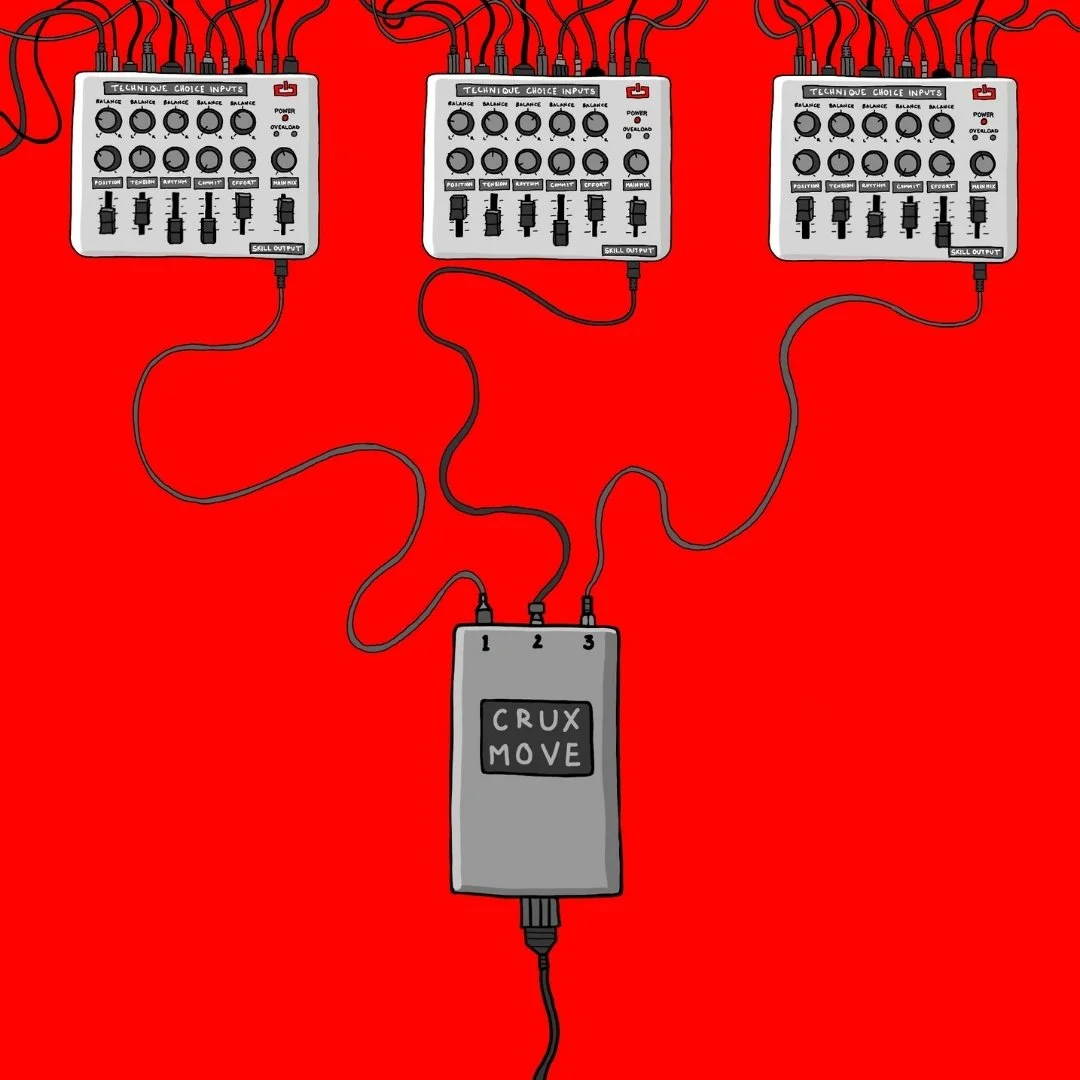
Tension. Position. Rhythm. Commitment. Effort.
Yes, the 5 Atomic Elements of Climbing Movement. The foundations of how we do moves.
With those ideas front of mind, I did the move twice in a row. Not well, mind you, but I did it.
Then, as I started to pack up, I realized something. I turned to my wife and said, “I think I can just do this right now.”
I repositioned the pads, sat down, and did it on my first redpoint attempt.
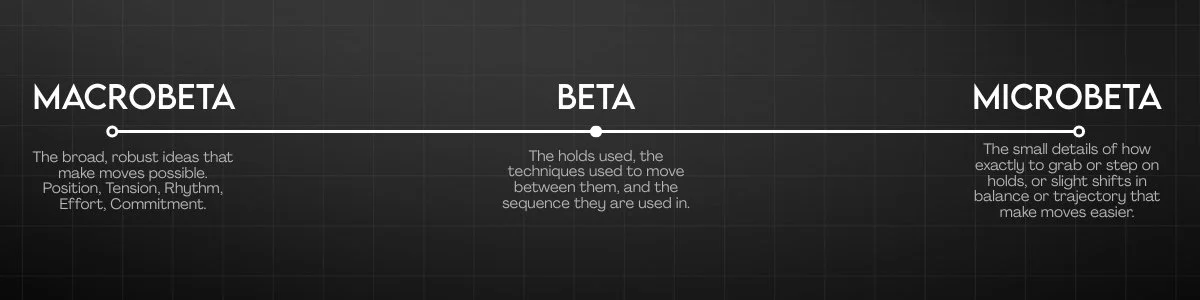
It wasn’t until the next morning that I made the connection with what I’d done and the 5 Atomic Elements. I’d realized long ago, while trying to boil movement down to it’s foundations, that we use the language of the 5 Elements when discussing moves, but I had really only applied them to assessing and improving our movement skills. I hadn’t realized how valuable they were in a tactical sense. I sat down and talked through this concept for the Patrons in a “Connect The Dots Freestyles” episode, and that led me to the idea of the above spectrum of beta.
We can, when needed, figure out the ratio of elements used for the hardest moves and adjust them until we get it right. In my estimation, these kinds of adjustments are going to have a bigger impact than the small details of microbeta.
That’s not to say that microbeta isn’t valuable — it definitely is — but it’s at it’s MOST valuable when the beta is sorted and the macrobeta is solid. THEN, when required, you can dive into the details.
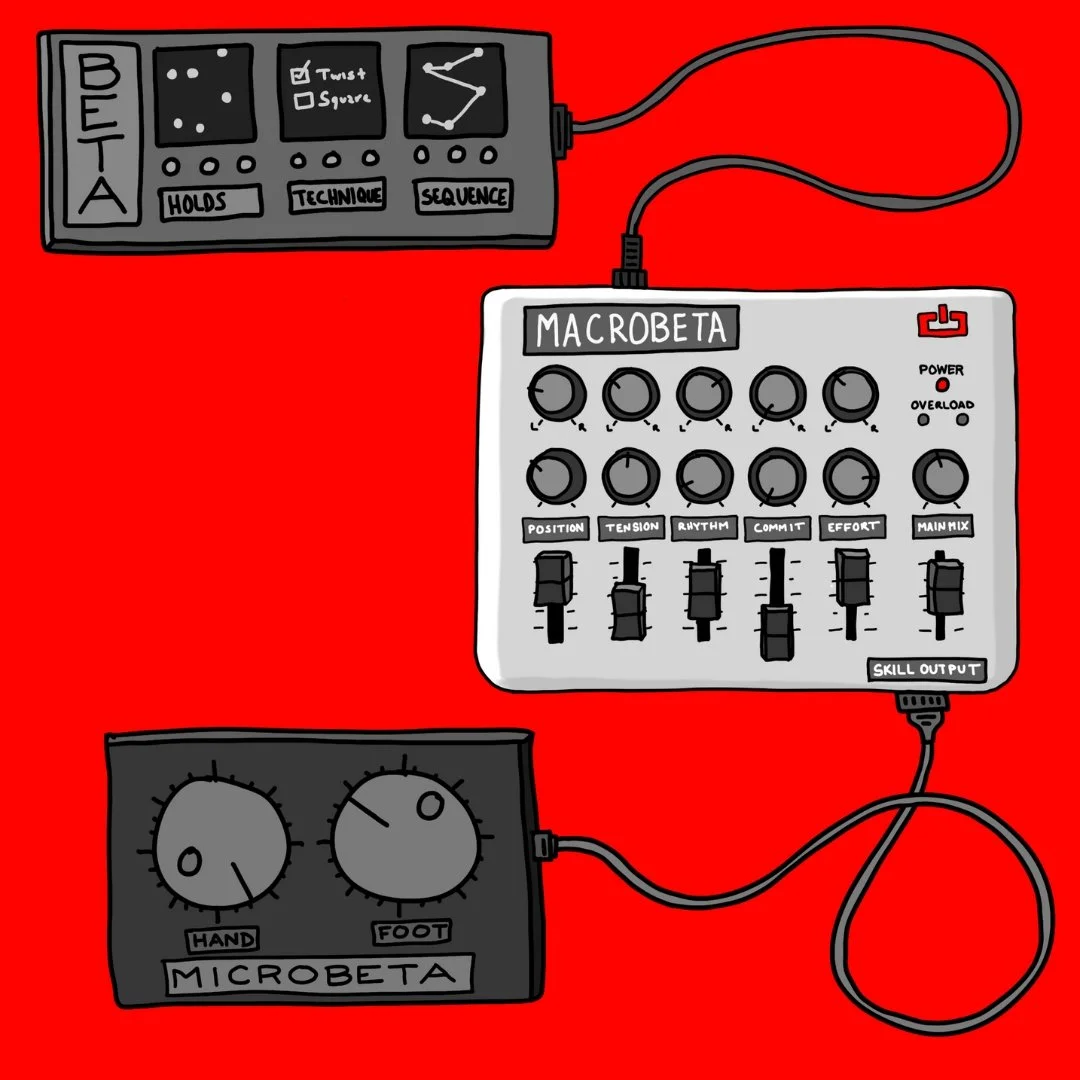
So I’m currently of the belief that we should save the microbeta for last. Find the beta then get the general macrobeta, then make further necessary adjustments through both macro and microbeta.
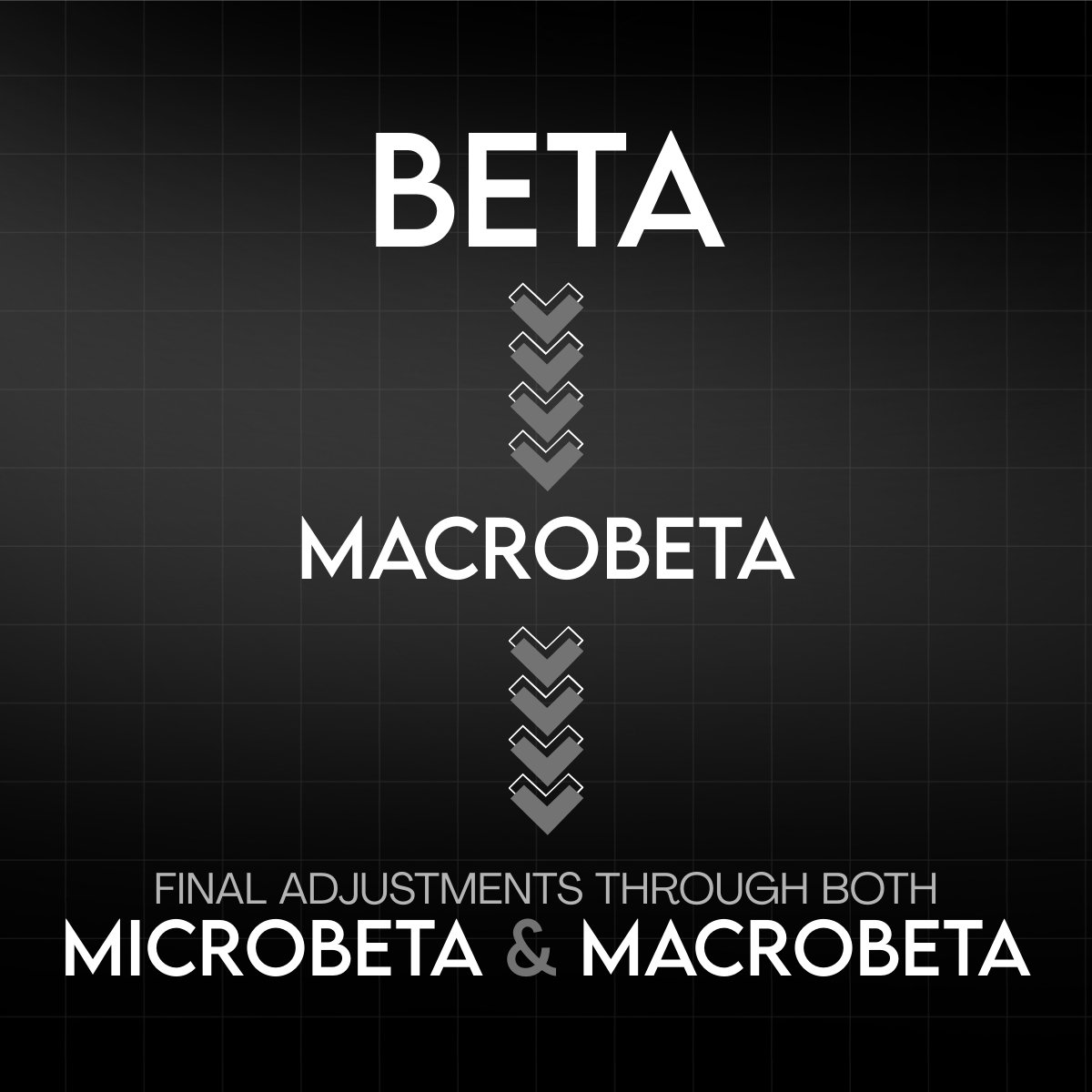
I believe this order of operations works best because there is the distinct possibility of sending way before you spend time working on the tiny details. If the difficulty is well below your level, you can likely do it on step 1, the general beta. A little harder requires some extra macrobeta adjustment. The next levels up needs more attention to detail, and as you get to your absolute hardest projects, the final however many sessions may be entirely dialing the microbeta.
The Problem with Microbeta
We LOVE figuring out the microbeta, but in practice, it’s fragile. Under pressure or fatigue, it’s often the first thing to fall apart. It’s incredibly susceptible to compounding errors.
You catch the hold wrong and because of that you can’t quite get the foot right. Then because of that you lose some momentum going to the next hold and hit it wrong. And so on.
However, we often do the move anyway.
Not to mention, when we jump into the microbeta too early, we risk not realizing that we don’t even have the best beta yet. Then when something that’s clearly better presents itself, we stick with the beta that includes our hard-won microbeta because we’re human and easily fall into the sunk-cost fallacy.
That’s not to say it’s a waste of time. It isn’t. Particularly as you’re developing as a climber, following the wrong beta down the path to extreme microbeta, even when you end up not needing it, is still developing awareness.
In fact, we have to get it wrong a lot of times to get better at calibrating our awareness. To know when to quickly discard something and when to hold on to something unlikely.
I suppose that officially kicks off tactics season. I hope to do with tactics what I did with movement, and find a more intuitive way to look at them versus our current method of “every situation is different.” I’m not entirely sure what shape that takes yet, but you’ll be hearing about it regularly starting now.
Learn. Grow. Excel.
– Kris
Related Things to Stay Current:
I’ve recently gone deep, deep, deep into grades on both the YouTube and in Freestyles with the Patrons. Hate them or love them, grades are what we have, and with a shifted perspective they can be incredibly valuable AND make a lot of sense. Yes, I said make sense.
I recently moved our first 100 patron only episodes into a FREE membership tier. No strings attached. Once you’re in, go to the “Collections” section and you’ll find a free bonus episode collection so that you don’t have to scroll back. If you’re on Spotify, you can connect your account and they’ll show up there as well.
Don’t forget! If you aren’t on the email list for THE CURRENT, you won’t get the email next month. Make sure you’re subscribed HERE.
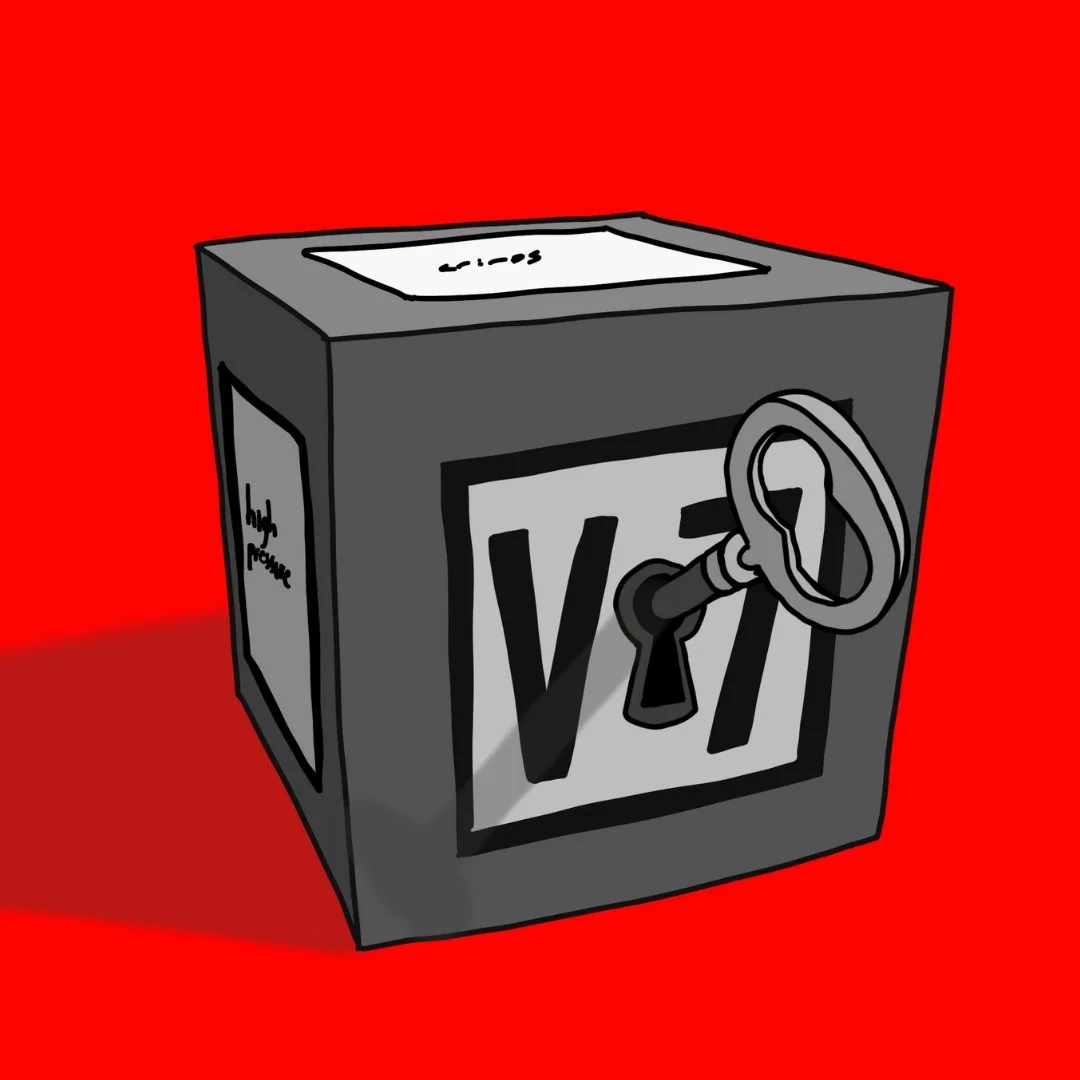








Maybe not. As always, it depends.